Jewish History

Content type
Collection

Donald and Fran Putnoi

Project
Soviet Jewry

Gabriel Weinstein, Tamar Shachaf Schneider, and Aaron Hersh interviewed Donald and Fran Putnoi in Massachusetts, as part of the Soviet Jewry Oral History Project. Fran and Dr. Donald Putnoi share their involvement with Action for Soviet Jewry, discussing their experiences with Rabbi Mehlman, missions to the USSR, treating patients, and their efforts in supporting Soviet Jews resettling in the United States.

Anna Charny

Project
Soviet Jewry

Gabriel Weinstein Tamar interviewed Anna Charny in Massachusetts as part of the Soviet Jewry Oral History Project. Charny shares her experiences growing up in Moscow, encountering antisemitism, becoming a refusenik, and eventually immigrating to the United States, highlighting her family's Jewish identity, her activism, and the challenges of assimilating into a new country.

Alla (Hannah) Aberson

Project
Soviet Jewry

Alla Aberson was interviewed in Framingham, Massachusetts, as part of the Soviet Jewry Oral History Project. Aberson discusses her parents' "refusenik" jobs, life under KGB surveillance, participation in hunger strikes, antisemitism in the FSU, and their path to leaving the Soviet Union.

Judith Wolf

Project
Women Who Dared

Julie Johnson interviewed Judith Wolf on February 23, 2005, in Boston, Massachusetts, as part of the Women Who Dared Oral History Project. Wolf reflects on her Jewish upbringing, volunteer work, religious schooling, and efforts to establish educational resources for disabled children in Ukraine, emphasizing the role of women and Jewish values in her life.

Flora Benenson Solomon

Flora Benenson Solomon’s deep commitments to welfare and Zionism traversed geographical boundaries and social groups. From her efforts to improve the lives of Jewish and Arab communities in Palestine to the her work on behalf of garment workers in England, Solomon maintained an unwavering commitment to Zionism, which acted as a sustainer of Jewish identity in England.  

Aliza Parker

Project
General

Jayne Guberman interviewed Aliza Parker on February 13 and March 28, 2008, in Brookline, Massachusetts, as part of the Jewish Women's Archive's general oral history project. Parker discusses her family history, upbringing in Brooklyn, involvement in Zionist youth movements, experiences in Israel, teaching career, participation in a Jewish study group, and reflections on her marriage, children, and the evolving world and Israel.

Episode 92: Beyond the Binary: Making Hebrew More Gender-Inclusive

Hebrew is a very gendered language; every noun in Hebrew is either feminine or masculine. So are pronouns, including “I” and “you.” This makes it nearly impossible to utter a sentence in Hebrew without using gender. So as a Hebrew speaker, how do you refer to a mixed-gender group? What about nonbinary people? In this episode of Can We Talk?, we speak with Michal Shomer, Dafna Eisenreich, and Tal Janner-Klausner, three activists who are taking Hebrew beyond the gender binary and promoting a Hebrew language that includes people of all genders.

Episode 91: Israel at 75: Voices of Protest

Israel turns 75 this week. This milestone comes at a moment of unprecedented upheaval in Israeli society and escalating violence between Israelis and Palestinians. Over the past few months, around 1.5 million Israelis have poured into the streets to protest the judicial reforms proposed by Netanyahu’s far-right coalition government, which would weaken the power of the Supreme Court.

In this episode of Can We Talk?, we'll hear four Jewish Israeli women from diverse backgrounds reflect on how the country arrived at this tumultuous moment. They'll talk about their hopes and fears for the country, and what the protests have meant to them.

Jill Freedman in Jewish Cemetery

Q & A with Susan Chevlowe, curator of "Missing Generations: Photographs by Jill Freedman"

Jen Richler

JWA talks to Susan Chevlowe, curator of a new exhibition of photographs by Jill Freedman that documents the destruction and resurgence of Jewish life after the Holocaust.

Sara Dalkowitz Kaplan

Project
Weaving Women's Words

Roz Bornstein interviewed Sara Kaplan on December 4, 2002, in Seattle, Washington, as part of the Weaving Women's Words Oral History Project. Kaplan discusses her Jewish upbringing, experiences as the only Jewish kid in her town, involvement in debate and Hillel, meeting her husband, moving to Seattle, working in the Democratic Party, fighting antisemitism, teaching, and support for Israel.

Naomi Rosenblatt

Project
Washington D.C. Stories

Deborah Ross interviewed Naomi Harris Rosenblatt on December 31, 2010, in Washington, D.C. as part of the Weaving Women's Words Oral History Project. Rosenblatt details her personal journey from witnessing the birth of Israel to her career in Washington, D.C., discussing her deep connection to Jewish identity, the intertwining of the Bible and psychotherapy, and her concern for the future of the Jewish people.

Ronya Schwaab

Project
Women Whose Lives Span the Century

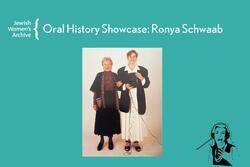
Vicki Gabriner interviewed Ronya Schwaab on January 18 and 26, February 3 and 7, and June 18, 1997, in Boston, Massachusetts, as part of the Women Whose Lives Spanned The Century Oral History Project. Schwaab recounts her childhood in Gomel, Belarus, highlighting aspects such as the First World War, Jewish traditions, women's roles, interfaith relations, arranged marriages, and encounters with the anti-revolutionary group, the Chyornaya Sotnya.

Collage of Alexa and Brennon Lemieux from Netflix's Love is Blind on purple patterned background

Celebrating An Inter-religious Couple on Love Is Blind

Sonia Freedman

Although I was somewhat unimpressed by Love Is Blind’s surface-level coverage of inter-religious relationships, it was beautiful to watch the Lemieux fall in love despite their very different backgrounds.

Collage of Lily James in The Exception on purple patterned background

The Exception's Antisemitism Is, Unfortunately, Not An Exception

Olivia Gnad

Between using atrocities as a way to create romantic drama and its rush to excuse antisemitism, The Exception is a movie that never should have left the writer's room.

Line drawings of a book and pens on light blue background

Interpreting The Sun Also Rises

Maya Viswanathan

Reading The Sun Also Rises was the first time I encountered depictions of antisemitism as an almost normal part of conversation and interaction. I didn’t know how to react to it.

Galina Nizhnikov

Project
Women Who Dared

Judith Rosenbaum interviewed Galina Nizhnikov in Peabody, Massachusetts on January 12, 2003, as part of the Women Who Dared Oral History Project. Nizhnikov talks about her upbringing in Russia, her family's Jewish pride, experiences with workplace antisemitism, involvement with refuseniks, the decision to leave Russia, and the struggles they faced to secure their departure.

Marillyn Tallman

Project
Women Who Dared

Rosalind Hinton interviewed Marillyn Tallman on February 2, 2005, in Chicago, Illinois for the Women Who Dared Oral History Project. Tallman talks about her childhood, activism work, involvement in the Civil Rights Movement, and her Jewish life and Zionist beliefs.

Magda Schaloum

Project
Weaving Women's Words

Roz Bornstein interviewed Magda Altham Schaloum, on June 5, 2001, in Mercer Island, Washington, for the Weaving Women's Words Oral History Project. Schaloum shares her experiences growing up in Hungary, including enduring antisemitism, the impact of anti-Jewish laws, her family's separation and deportation to Auschwitz, her survival through slave labor camps, and her life after the war, including immigrating to Seattle and building a new life with her husband and children.

Episode 88: Jewish Women Behind the Mic

Here at Can We Talk?, we’re podcast fanatics. And we especially like shows that feature Jewish women’s voices. So we decided to bring together some of our favorite Jewish women podcasters to talk shop. In this episode of Can We Talk?, Judith Rosenbaum takes us behind the scenes with Stephanie Butnick from Unorthodox, Judy Gold from Kill Me Now, and Emily Bazelon from Slate's Political Gabfest, to talk about what makes their shows Jewish, sharing the mic with men, and answering to their listeners.

Judith Chalmer

Project
DAVAR: Vermont Jewish Women's History Project

Sandra Stillman Gartner and Ann Buffum interviewed Judith Chalmer in Winooski, Vermont, on November 3 and December 8, 2005, as part of DAVAR’s oral history project. Chalmer discusses her family's history, her creative path as a writer, and her reflections on her Jewish identity and the role of women in Judaism, inspired by her father's experiences during the Holocaust and her efforts to honor those who helped her family.

Sherry Gorelick

Project
Barnard: Jewish Women Changing America

Jayne Guberman interviewed Sherry Gorelick on October 30, 2005, in New York, New York, as part of the Barnard: Jewish Women Changing America Oral History Project. Gorelick discusses her upbringing, Jewish activism, feminism, and her experiences with the Israeli-Palestinian conflict, including her involvement in peace conferences, the Gay and Lesbian Movement in Israel, and her recent diagnosis of multiple sclerosis.

Batya Gur

Israeli author Batya Gur is best known for her mystery novels centering on the investigations of detective Michael Ohayon. Her work brought literary complexity to the Hebrew mystery novel.

First Second Wave Jewish Feminist Conference in North America Begins

February 16, 1973

In February 1973, 500 women gathered in the McAlpin Hotel in Manhattan for the first second-wave Jewish feminist conference in North America. Speakers and attendees discussed Jewish religious observance, issues of sexuality, duties of community service, inequality in Jewish movement organizations, and experiences of growing up in Jewish families. The conference brought Jewish women of many backgrounds together under a shared feminist identity.

Image of the hebrew letters samech, tav, resh on one row, followed by tav, resh, samech, on the row underneath

Esther and Teresa: A Play on Words for Purim

Ellen Kanner

This Purim, learn all about Teresa de Lucena, a conversa who revered Queen Esther. 

Topics: Purim, Antisemitism

Yemema Seligson

Project
Women Whose Lives Span the Century

Joan Rachlin interviewed Yemema Seligson on January 7, 1998, in Brookline, Massachusetts, for the Women Who Lives Spanned the Century Oral History Project. Seligson reflects on her family's immigration, her mother's work as a seamstress, childhood memories, the friendship with linguist Eliezer Ben-Yehuda, her career journey, and her current life, activities, and friendships.

Donate

Help us elevate the voices of Jewish women.

donate now

Get JWA in your inbox

Read the latest from JWA from your inbox.

sign up now