Jewish History

Content type
Collection

Teresa de Lucena

Teresa de Lucena was born in Toledo, Spain, in 1467, the fifth of six daughters in a distinguished converso family. She faced the Spanish Inquisition twice—at seventeen and at 62—and she survived. Details about how she and her peers defied the Inquisition and continued to practice Judaism in secret come to life in her trial testimony, captured by scribes as she spoke.

Miriam Novitch

Miriam Novitch was a member of the French Resistance during World War II and, after, an advocate for education on the Jewish resistance and the experiences of Holocaust survivors. She was one of the founders of the Itzhak Katzenelson Holocaust and Jewish Resistance Heritage Museum (also known as the Ghetto Fighter’s House, or GFH) and served as the curator for its art collection for many years. 

Episode 114: Can We Talk? 2023-24 Season Wrap

In this episode of Can We Talk?, Jen, Nahanni, and Judith recap the past two seasons of the podcast, in which we entered the uncharted territory of a post-October 7 world. We discuss our approach to creating episodes about Jewish women’s responses to the attack on Israel and the ensuing war in Gaza, while still making space to tell stories about other aspects of Jewish life.

The Moneylender and his Wife by Quentin Matsys, 1514

Tzedek in Action: The CFPB's New Rules

Zia Saylor

By creating rules that restrict banks from charging excessive fees, the CFPB is pursuing the Jewish concept of tzedek.

Episode 113: Getting Out Of Gaza

Since Hamas’s brutal attack on Israeli civilians on October 7, Can We Talk? has focused on Israeli women’s responses to the war. In this episode, we turn our attention to Gaza, where Israel’s sustained bombardment has taken a terrible toll—tens of thousands of people have been killed, nearly two million people have been displaced, and the medical system is in ruins. Over a hundred thousand Palestinians have fled Gaza for Egypt in the past eight months. Human rights activist Jen Marlowe has been raising money and working to help people with the expensive, bureaucratic and logistically complicated border crossing. In this episode of Can We Talk?, we speak to Jen about her recent trip to Egypt to meet with some of the people she has helped get to safety, the conditions people face in Gaza, and what it’s like for her, a Jewish woman, to do this work.

Charlotte Charlaque

Finding Strength in My Transcestor

Ariadne Wolf

My great-aunt Charlotte has taught me so much. But until recently, I didn't even know she existed. 

Michelle Azar as RBG

What Would Ruth Say?

Michelle Azar

A post-show conversation about RBG and Israel leads to a moment of connection. 

Topics: Theater, Israel

Episode 111: Ladino Makes a Comeback

Segun el tiempo, se abolta la vela. That’s a Ladino saying that means, “According to the weather, shift your sail.” And it's an apt way of describing Ladino's recent comeback. Ladino—or Judeo-Spanish—the language spoken by Sephardic Jews in Turkey, Greece and North Africa, saw a major decline after the Holocaust destroyed communities of native speakers. But like a sailboat shifting course when the wind changes direction, Ladino has adapted to the times. In this episode of Can We Talk, you’ll hear how from Naomi Spector and Nesi Altaras, two Ladino enthusiasts, and from Hannah Pressman, one of the people spearheading Ladino’s resurgence.

Berta Singerman

Berta Singerman (1901-1998) was an Argentine actress and reciter of poetry, famous throughout the Ibero-American cultural world. Born in Russia to a family of traditional singers (chazanim), she immigrated to Buenos Aires, Argentina, when she was four years old.

"The Book Of Jerusalem" Cover

"The Book of Jerusalem" by Julia Vinograd

Mildred Faintly

Out of her personal suffering and poetic genius, Julia Vinograd created an iconic image of Jerusalem that is powerful, feminist, and unforgettably, startlingly modern.

black and white drawing of people dancing in couples at a ball, circa 1800s

Scandalous Dance Scenes, Romance Plots, and Jewish Literary Modernity

Sonia Gollance

Long before Fiddler on the Roof, Jewish writers used partner dance as a powerful metaphor for social changes that transformed Jewish communities.

Episode 110: Oral History Showcase: Leni's Ladino Legacy

Lenora LaMarche, better known as Leni, was born in 1921 in the Sephardic Jewish community in Seattle, Washington after her parents moved there from Rhodes, looking for better economic opportunities. She grew up speaking Ladino, and for over 30 years, she wrote a Ladino column in her synagogue newspaper called "Bavajadas de Ben Adam"—people’s foolish little words.
In this episode of Can We Talk?, you’ll hear excerpts from an interview she did in 2001 for the “Weaving Women’s Words '' oral history project, in which she reflects on her Sephardic heritage and peppers her stories with colorful Ladino words and sayings. Her testimony is one of hundreds in JWA’s Tanner Oral History Collection.

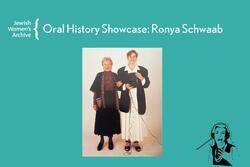
Episode 109: Oral History Showcase: Ronya's Liberation Story

When Ronya Schwaab was a young girl, the highlight of her year was preparing for Pesach—the snow was melting, and she got to help bake matzos. Ronya was born in 1909 in Belarus. She grew up amidst the violence and antisemitism of World War I and the Russian Revolution, and immigrated to America as a teenager. As an adult, Ronya devoted her life to helping other Jews escape from the Soviet Union. In this episode of Can We Talk?, you’ll hear excerpts from an interview she did in 1997 for the “Women Whose Lives Span the Century '' oral history project, a partnership between JWA and Temple Israel of Boston. Her testimony is one of hundreds in JWA’s Tanner Oral History Collection.

Julie Johanna Engel

Julie Johanna Isner Engel dreamed of becoming a professional opera singer in Germany in the 1930s, but the rise of the Nazis interrupted that dream. Escaping to the United States, she trained her voice in synagogue choirs and local opera performances. In the 1970s, she took a cantorial position at a synagogue in Queens, one of a pioneering generation of women cantors.

"Letters from Rifka" book cover

From 'Rifka' to a Lifelong Love of Jewish Books

Isadora Kianovsky

It was through Jewish books that I, and many women like me, learned to challenge the world around us, just as Rifka did. 

Sabina Vajraca and a poster from Sevap/Mitzvah

Q & A with Sabina Vajraca about her New Film, "Sevap/Mitzvah"

Mirushe "Mira" Zylali

JWA chats with Sabina Vajraca about her new film Sevap/Mitzvah, inspired by a remarkable true story of female friendship and our common humanity.

Image from JIMENA Sephardi and Mizrahi Toolkit

JIMENA's New Sephardi and Mizrahi Education Toolkit

Lizzy Danon

JWA talks to Sarah Levin, executive director for Jews Indigenous to the Middle East and North Africa (JIMENA) about its new Sephardi and Mizrahi Education Toolkit. 

Collage of "Do Revenge"

The Subtle Antisemitism of "Do Revenge"

Halleli Abrams Gerber

The film is inclusive in terms of race, sexuality, income, and more. However,  Max Broussard, the high school’s “king" embodies many of the worst stereotypes that Jews face.

Topics: Film, Antisemitism
Collage of Alte Zachen

Healing Trauma through Intergenerational Relationships in "Alte Zachen"

Julia Brode Kroopkin

In addition to sharing messages of patience, understanding, and unwavering love, Alte Zachen balances stories of Jewish suffering with stories of Jewish joy.

Episode 106: A Pocket of Hope: Israeli Women Building a Shared Future

“From the deepest crises come the clearest visions…We're fighting for our lives. We're fighting for our future,” says Sally Abed from Standing Together, a grassroots political movement in Israel. In this episode of Can We Talk?, we hear from Jewish and Palestinian citizens of Israel who are working on shared society initiatives, even in the midst of the war. Sally, as well as Hanan Alsanah, Ayesha Ziadna, Khitam Abu Bader, and Racheli Geffen, talk about how the war has affected their lives, work, and identity; the unique qualities women bring to social justice work; and their vision for a shared future. Jen Richler recorded their remarks during a women’s mission to Israel in January 2024 co-organized by the Jewish Women’s Archive.

Rokhl Auerbakh

Rokhl Auerbakh Made Me Rethink Holocaust Remembrance

Maya "Zuni" González

Reading Auerbakh's essays in the original Yiddish in the lead-up to International Holocaust Remembrance Day changed my perspective.

Topics: Holocaust
Young woman with dark hair and black sweather standing in front of a pillar

Where Are They Now? RVF Alum Isabel Kirsch

Sarah Biskowitz

JWA talks to Rising Voices Fellowship alum Isabel Kirsch for our series marking the 10th anniversary of the fellowship.

Black and white hand holding a Jewish star

The Silence That Frightens Me

Jessica Primus

For me, being pro-Israel is about valuing the lives of Jews everywhere, despising antisemitic actions and rhetoric, and ensuring that Jews will always have a homeland to go to avoid religious persecution.

Topics: Antisemitism, Israel
Collage of Ora Namir on grey blue background

Learning from Ora Namir and Advocating for a Better Israel

Lily Katz

The actions taken by so many progressive Israelis against their far-right government have inspired me to consider the history of activism and fights for equality within the state of Israel. I am particularly inspired by the legacy Ora Namir left for Israeli women.

Collage of Jewish Women Who Died in 2023

Jewish Women Whose Memories I’m Carrying into 2024

Judith Rosenbaum

The year 2023 brought the deaths of several powerful and influential Jewish women, whose insights and voices changed the world and are all the more painful to lose in this difficult time. 

Donate

Help us elevate the voices of Jewish women.

donate now

Get JWA in your inbox

Read the latest from JWA from your inbox.

sign up now