
Women of Solomon: Bible

King Solomon with three of his wives by Giovanni Venanzi di Pesaro. Oil on canvas, 1668. Source: Dorotheum, via Wikimedia Commons.
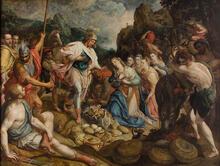
The hundreds of women said to have married King Solomon or reside in his harem described in the Book of Kings included the daughter of Pharaoh and women of Moabite, Edomite, Sidonian, and Hittite origins. As in several (but not all) other Biblical stories, the foreign women in Solomon’s story represented the threat of foreign influence on Israelite society.
Article
Solomon, third king of Israel (reigned c. 968–928 B.C.E.), is said to have had a harem that included 700 wives and 300 concubines (1 Kgs 11:3). His wives were to have included the daughter of Pharaoh, as well as women of Moabite, Edomite, Sidonian, and Hittite origins (1 Kgs 7:8; 11:1). The latter group is usually understood to represent wives who were added to the harem as a means of sealing treaty agreements with these five foreign powers. Throughout human history, marriage alliance has been the most common way for rulers to attempt to secure peaceful relationships with potential enemies.
The tradition in 1 Kgs 11:1–8 about Solomon’s marriage to foreign wives, whether based on historical records or not, employs the motif of the dangerous foreign woman to condemn Solomon for idolatry in his later years (see Neh 13:26). It seems to illustrate the prohibition in Deut 7:3 against marrying foreign women and also to echo the exclusion of Moab and Edom from the congregation of the Lord in Deut 23:4–9. Foreign women were considered a potential source of trouble because they might not always adopt the culture and values of their husbands and their new place of residence. If they chose to continue to practice their native customs and cults, they would pass these on to their children and might also influence their husbands to adopt some non-Israelite practices as well. Loyalty to and identity with Israelite tradition would be threatened.
In biblical literature, foreign women, seduction, prostitution, sexual disloyalty, and fertility cults were often linked together, yet not all foreign women were viewed as evil. Tamar (Genesis 38), Ruth (Book of Ruth), Rahab (Joshua 2), and Jael (Judges 4–5) provide positive images of foreign women; each demonstrates through her behavior her adoption of Israelite or Judahite society and religion and gains acceptance in her new community. Solomon’s foreign wives, by contrast, depict the negative side of foreign women. Like Potiphar’s wife (Genesis 39), Samson’s wife (Judges 14–16), and the foreign woman of Proverbs 1–9, they remain loyal to their own personal or political interests and, as a result, disrupt law and order in their adoptive Israelite community.
Brenner, Athalya. The lsraelite Woman: Social Role and Literary Type in Biblical Narrative. Sheffield, England: 1985.
Meyers, Carol, General Editor. Women in Scripture. New York: 2000.
Miller, J. Maxwell, and John H. Hayes. A History of Ancient Israel and Judah. Philadelphia: 1986.
Reinhartz, Adele. “Anonymous Women and the Collapse of the Monarchy: A Study in Narrative Technique.” In A Feminist Companion to Samuel and Kings, edited by Athalya Brenner, 43–65. Sheffield, England: 1994.