Rose Gruening
1876 – 1934
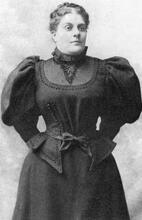
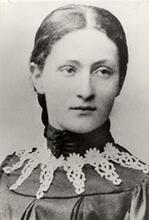
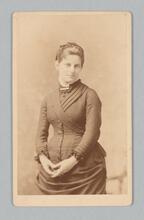
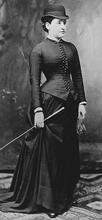
Known during her lifetime as the “Angel of Grand Street,” Rose Gruening was head worker and founder of the Grand Street Settlement in New York City. Although Gruening never liked this title, it attests to her significance in the eyes of many people. Like Jane Addams, Lillian Wald, and other women settlement workers of the early twentieth century, Gruening helped to create a social “safety net” through voluntary civic activism, before the concept of public responsibility for poor and disadvantaged Americans was enacted by the U.S. Government. Once the Depression and the New Deal transformed the workings of social welfare in the United States, the social service concept as practiced by Gruening and her contemporaries changed dramatically. Before it did so, however, thousands of immigrant families from the Lower East Side of New York experienced Gruening’s settlement house activism in personal and profound ways.
By the time Gruening established the Grand Street Settlement in 1916, she was intimately familiar with both the urban environment of New York and social service work. Rose Gruening was born in New York City in 1876 to Rose (Fridenberg) and Emil Gruening, a well-known eye and ear specialist. The elder Rose Gruening died of typhoid fever when giving birth to her daughter. Four years later, young Rose’s father married his late wife’s sister Phebe and with her raised four more children: Clara, Marie, Martha, and Ernest. Both Clara and Martha became writers, and their brother became a well-known journalist and editor for such newspapers as the New York Evening Post and the New York Tribune. Growing up in New York City near Gramercy Park, Rose Gruening attended the Ethical Culture School and later graduated from Vassar College. While the Gruenings subsequently moved their family home uptown to 57th Street, Rose Gruening began to focus her professional interests even farther downtown, on Manhattan’s Lower East Side.
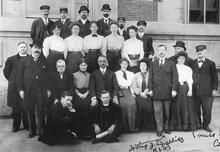
Gruening began her philanthropic career as a volunteer social worker in Madison House, the Ethical Culture Society’s settlement on the Lower East Side. Accounts of Gruening’s early career suggest that she first became interested in social work after college, when she visited an Ethical Culture School summer camp for poor children. In 1907, after having joined the staff of Madison House, Gruening persuaded its trustees to establish a summer recreation spot in Mountainville, New York, for the settlement’s urban dwellers. She called it Camp Moodna. Housing at Camp Moodna originally consisted of twenty converted horse cars, which Gruening obtained inexpensively from a transit company that was about to replace its older, horsedrawn cars with trolley and cable cars.
Over the next few decades, Camp Moodna changed hands as Gruening expanded her settlement house work. By 1916, Madison House was serving more people on the Lower East Side than it could easily accommodate. Rather than build an even larger Madison House, though, Gruening and some of her colleagues wanted to establish a smaller settlement in an underserved neighborhood. Gruening founded the new settlement on Division Street and named it the Arnold Toynbee House after the famous British social reformer. After three years, the settlement moved to larger quarters on the corner of Grand Street and East Broadway, aiming to improve the living and working conditions of people in the community by addressing the underlying causes of their poverty. During the 1920s and 1930s, the settlement organized children’s social clubs, offered child care for working parents, and provided showers for community residents whose homes had no running water. In 1925, its name was changed to the Grand Street Settlement, and during the Depression years, Camp Moodna was donated to the Grand Street Settlement in honor of Gruening.
Rose Gruening died at Camp Moodna on July 31, 1934, but the legacy of the “Angel of Grand Street” continues at the Grand Street Settlement even today.
Bibliography
AJYB 37:257; EJ; Gruening, Ernest. Many Battles: The Autobiography of Ernest Gruening (1973); Obituary. NYTimes, August 1, 1934, 17:4.
Discuss
This encyclopedia was first published in 2005. Do you have updates to this person's life? Links to online resources of interest? Are there areas of this person's life you feel should be mentioned in the article, or mentioned in more detail? Let us know.
totem pole
my family is trying to find out about Camp Moodna, my Uncle went there I believe in the 1940s and carved a totem pole, he became a reknowned sculptor attended Art Students League apprenticed with Jacque Lipschitz etc we'd like to know if the totem pole is still standing or what became of it, his name is
Sol Lefkowitz.
Thanks!
camp moodna
I am one of the owners of the propery up the hill that we always thought was Camp Moodna and for the first time am seeing Camp Gruening. Does anyone have any pictures of either would love to see them. John Hand
camp Moodna past 1955
My childhood years were spent at Camp Moodna.. My mother and I went to Camp Rose Gruening (up the hill) and my brother went to camp Moodna.. we got to see him once a week. I have a picture of me at age 2 at the camp... We too, went the first trip because it was three weeks, but in the summer of 1955, we went on the second trip because it was my brother's Bar Mitzvah year.. I was 5 , yet I still recall how my brother lost everything in the flood..
Since I was still young, I continued going to Camp Moodna when it was relocated to East Stroudsberg Pa... My Mother continued going to Camp Rose Gruening.. When I was 7, I started going to camp Moodna and then I too only saw my mom once a week.. I remember getting the T award and 2 stars and still have them in my possession....Those were the best summers.. I stopped going in 1962.. My parents and Brother were holocaust survivors and had only been in the country a couple of years.. The Grand Street Settlement house was a blessing.......... Anyone out there remember Camp Moodna in East Stroudsberg,PA?
I went to Camp Moodna in E.
I went to Camp Moodna in E. Stroudsburg in the early 60s to mid 60s. I loved it. I was working at Tamiment, which was nearby, in 1969 and my friend and I went over to Moodna. I wanted her to see it. We drove onto the property and there was a man there who pulled out a rifle and pointed it at us. We headed out as fast as we could.
Camp Moodna in East Stroudsburg
I remember the East Stroudsburg Camp Moodna very well. i was a camp counselor the summer of '67 and met my husband there. He, Manny Taylor, was one of the camp chefs. We married the following spring and went back for 2 more summers. Unfortunately, the camp was sold before the camp season of '70. It was a wonderful camp in a beautiful part of the Poconos where you could look out and see the Delaware Water Gap. And it had great programs for the kids. We were so sorry to see Camp Moodna come to an end.
Camp Moodna
I attended Camp Moodna until 1955 when it was destroyed in Hurricane Diane (1955). That year I received Honorable Mention for a T. I was always on the "first trip" which was three weeks long, while the others were only two weeks. For me Camp Moodna was a bit of heaven, having grown up on Cannon St where a tree was a rarity. Does anyone have any pictures of the camp? Although I do not live in the US, I dream about visiting the old site.
Camp Moodna
I attended Camp Moodna until 1955 when it was destroyed in Hurricane Diane (1955). That year I received Honorable Mention for a T. I was always on the "first trip" which was three weeks long, while the others were only two weeks. For me Camp Moodna was a bit of heaven, having grown up on Cannon St where a tree was a rarity. Does anyone have any pictures of the camp? Although I do not live in the US, I dream about visiting the old site.
camp moodna
I attended Camp Moodna for five summers in the late 1940's; they were the happiest summers of my life. In those days there wa no airconditioning and the city streets were sweltering. Any child who was lucky enough to go the country was blessed. The greatest time was when the bues pulled up in front of the Grand St Settlement to take us to Mountainville and wonderful Camp Moodna.
We went swimming in the creek, rock climbing on the other side of the dam, hiking up what we thought was the real Mohawk trail.
This was no sissy camp: we cleaned our own bunks, waited on tables in the messhall, showere in ice cold water and the like.
Although I did not live on the lowere east sie, I was able to go to Moodna prbably because someone took pity on me and let me be included.
Does anyone remember the G, the T, the two stars? There were honor awards for being a good camper. the names of the G winners were engraved on a special plaque in the mess hall.
Camp Moodna
I attended Camp Moodna for several years, until it was flooded by a storm that came up the Hudson Valley in the mid-1950s. The campers had been moved from the bunks to the mess hall, which had been surrounded by the waters of the flooded creek. They were rescued by soldiers from West Point, who came with amphibious vehicles and got them from the mess hall to Route 32. They were then taken up the hill to Camp Rose Gruening.
Camp Moodna 2010
The land that Rose Gruening donated to the Grand Street Settlement is now owned by the Storm King Mountain Art Center.
The land will never be developed and will be kept in its current status.Nature has reclaimed the land so that the open spaces I recalled as a camper are now gone and taken over by a very heavily forrested area.The Dam is still there although in poor condition.
As a member of the Storm King Mountain Art Center I am apprised of plans. The current plans are to leave the grounds as they are in order to provide a buffer between route 32 and the Camp Felicia side of Moodna Creek.
I took a hike into the forest and found the Handball court still there as well as foundations and stairs to the bunks. The old mess hall and wreck hall can be made out by the floors that remain in each building.
Schunemonk Mountain is likewise the property of Storm King Art Center.
Lastly, although now closed, the Ketcham General Store ( where we hiked as young campers) still stands in Mountainville.
Camp Moodna
Just the boys side belongs to Storm King Art Center, My brothers and I own the property on the other side of
rt 32 that was the girls camp. Growing up we explored the boys camp and found all kinds of things that were
part of the camp, we used the hand ball court for basketball, and the dam was a great swimming hole. Later on it was discovered by an older group of kids who used it for a hiding/party place, and littered the grounds with broken beer bottles, made fire pits, and generally destroyed the peaceful setting. The property we own is for sale.
Post new comment