
Judith Kaplan Eisenstein

The first American woman to celebrate a Bat Mitzvah, Judith Kaplan Eisenstein (1909 – 1996) later contributed to her culture as a successful composer and musicologist, publishing the first Jewish songbook for children. She is shown here in the early 1930s embarking on a trip with her family.
From left to right: Her sister, Naomi; her mother, Lena; her husband, Rabbi Ira Eisenstein; Judith; her father, Rabbi Mordecai Kaplan; and her sisters Selma and Hadassah.
Institution: The Ira and Judith Kaplan Eisenstein Reconstructionist Archives, Reconstructionist Rabbinical College.
The first American girl to publicly celebrate a bat mitzvah, Judith Kaplan Eisenstein went on to become a Jewish educator, composer, and musicologist. A musical and academic prodigy, Eisenstein studied at what would later become Juilliard and taught the history of Jewish music and music pedagogy at the Jewish Theological Seminary Teacher’s Institute, often creating her own course materials. She wrote the first Jewish songbook for children, as well as a history of Jewish music, five cantatas on Jewish themes, and two song cycles. She earned her PhD from Hebrew Union College-Jewish Institute of Religion’s School of Sacred Music in 1966 with a dissertation on Sephardic music and taught both at HUC-JIR and at the Reconstructionist Rabbinical College until her retirement.
Article
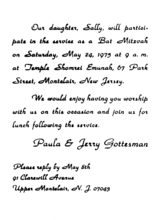
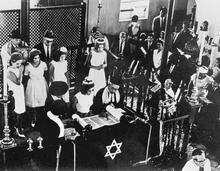
Before she was thirteen years old, author, composer, and musicologist Judith Kaplan Eisenstein was already a significant figure in Jewish history. The eldest of four daughters born to Lena (Rubin) and Rabbi Mordecai Menachem Kaplan, the founder of Reconstructionist Judaism, Judith Kaplan was the first young woman to celebrate a Lit. "daughter of the commandment." A girl who has reached legal-religious maturity and is now obligated to fulfill the commandmentsbat mitzvah publicly in an American congregation on March 18, 1922.
Neither of her parents was American born. Mordecai Kaplan, born on September 10, 1881, in Sventzian, Lithuania (near Kovno), arrived in the United States at age eight, after a year in Paris. In addition to rabbinic ordination from the Jewish Theological Seminary, he earned a degree from City College (New York City) and received graduate training at Columbia University in philosophy and sociology. Lena Rubin, born in Friedrichshaven, Germany (near the Polish border), was brought to New York as a three-year-old child.
Their daughter Judith was precocious intellectually (she learned to read English at age two and a half and began studying Hebrew at age three) and musically (between the ages of seven and eighteen, she studied at the Institute of Musical Art, now the Juilliard School, in New York). She also attended the Jewish Theological Seminary Teachers Institute and Columbia University’s Teachers College, where she received her B.S. (1928) and M.A. (1932) in music education. A brief marriage to Albert Addelston, on June 28, 1932, ended in divorce in Reno, Nevada, in September 1933. On June 10, 1934, she married Ira Eisenstein, then assistant rabbi at her father’s synagogue, the Society for the Advancement of Judaism.

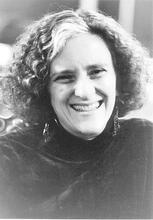
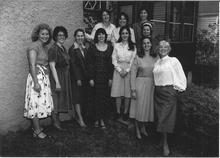
"No thunder sounded. No lightening struck," recalled Judith Kaplan Eisenstein of her history-making 1922 Bat Mitzvah ceremony, the first in America. She is pictured here at her second Bat Mitzvah ceremony, where she was honored by a number of prominent Jewish women, including Betty Friedan and Letty Cottin Pogrebin.
Institution: The Ira and Judith Kaplan Eisenstein Reconstructionist Archives, Reconstructionist Rabbinical College
From 1929 until 1954, Judith Kaplan Eisenstein taught music pedagogy and the history of Jewish music at Jewish Theological Seminary Teachers Institute. Where teaching and performing materials did not exist, she created them. Her publications include the first Jewish songbook for children, Gateway to Jewish Song (1937), Festival Songs (1943), Songs of Childhood (with Frieda Prensky, 1955), Heritage of Music: The Music of the Jewish People (1972), as well as five cantatas on Jewish themes written with Ira and two song cycles, all written between 1942 and 1974. In 1987, she created and broadcast a thirteen-hour radio series on the history of Jewish music.
In 1959, at age fifty, Eisenstein entered the School of Sacred Music of Hebrew Union College–Jewish Institute of Religion (HUC–JIR), where she received her Ph.D. (1966) with a dissertation on “The Liturgical Chant of Provencal and West Sephardic Jews in Comparison to the Song of the Troubadours and the Cantigas.” She then taught at HUC–JIR (1966 to 1979) and at the Reconstructionist Rabbinical College in Philadelphia (1978 to 1981).
The Eisensteins retired to Woodstock, New York, in 1981, and to Silver Spring, Maryland, in 1995. They had two daughters, Miriam Rachel Eisenstein, a lawyer with the U.S. Justice Department, and Ann Nehama Eisenstein, a therapist in private practice in New York, and one grandson. A son, Ethan Jacob, was institutionalized very young with severe intellectual disabilities.
Judith Kaplan Eisenstein began her adult life as an important figure in Jewish history. Talented and superbly literate in both Jewish and musical tradition, she expanded the understanding, enjoyment, and dissemination of the music of the Jewish people. She died on February 14, 1996.
Selected Works
Festival Songs (1943).
Gateway to Jewish Song (1937).
Heritage of Music: The Music of the Jewish People (1972, 1990).
“Medieval elements in the liturgical music of the Jews of southern France and northern Spain.” Musica Judaica 1, no. 1 (1975): 33-53.
The Music of the Jewish People. Set of thirteen audiotapes (1987).
“My Father, Mordecai.” Judaism 30, no. 1 (1981):11.
“No thunder sounded, no lightning struck.” Eyewitness to American Jewish History 4: 1915-1969, 30-32.
Our Bialik, with Ira Eisenstein (1945).
Reborn: An Episode with Music, with Ira Eisenstein (1952).
The Sacrifice of Isaac: A Liturgical Drama (1972).
The Seven Golden Buttons: A Legend with Music, with Ira Eisenstein (1947).
Shir ha-shahar [Song of the Dawn] (1974).
Songs of Childhood, with Frieda Prensky (1955).
Thy Children Shall Return, with Ira Eisenstein (1954).
What Is Torah she-bi-khetav: Lit. "the written Torah." The Bible; the Pentateuch; Tanakh (the Pentateuch, Prophets and Hagiographia)Torah, with Ira Eisenstein (1942).
Obituary. NYTimes, February 15, 1996.