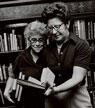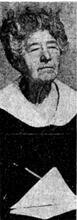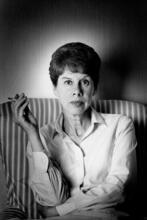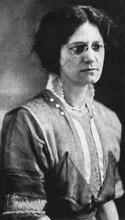

Ariel Durant

Born Chaya Kaufman, Ariel Durant married William Durant, a non-Jew who was thirteen years her senior, when she was just fifteen. She rebelled against domestic isolation, frequenting the bohemian haunts of Greenwich Village. Durant helped organize materials for the first five volumes of her husband’s popular summary of human history, The Story of Civilization. He included an essay on the roots of antisemitism in volume four, The Age of Faith, after Ariel insisted he fairly represent medieval Jewry. The Durants coauthored numerous works, including Rousseau and Revolution, for which they won the 1968 Pulitzer Prize. Indeed, they received worldwide acclaim, earning the US Presidential Medal of Freedom and medallions from the French government. The Los Angeles Times awarded Ariel Durant the 1965 Woman of the Year Award in Literature.
Early Life & Family
Ida Kaufman was a recalcitrant student, but after observing a Ferrer Modern School class meeting in Central Park, New York City, she immediately enrolled herself and promptly fell in love with her teacher, William Durant, thirteen years her senior. On October 31, 1913, at age fifteen, she roller-skated to her civil wedding ceremony at City Hall. Her new husband, a gentile, renamed her Ariel after the Shakespearean character.
Ariel Durant was born Chaya (her English name was Ida) Kaufman on May 10, 1898, in the city of Proskurov, or Chmelnitski, in West Ukraine, to Ethel Appel, the stylish and poetic daughter of a biblical scholar, and Joseph Kaufman, a struggling clothing salesman who subsequently immigrated to America in search of a better life for his family. With six children (Ariel was the fifth), her mother soon managed to reunite the family after a forced quarantine in England. In New York the family sold newspapers and moved constantly.
In Will and Ariel Durant: A Dual Autobiography, Ariel identifies with her mother’s “full and intense personality” and describes her mother’s plight with sympathetic poignancy. After the birth of a seventh child, Ariel’s worn-out mother denied her husband any further intimacies, and later moved out to pursue her bohemian and socialist interests. She maintained her ties to her family, however. When Durant married, her mother’s uncle objected so violently to Ariel’s being given “to a Godforsaken Gentile” that frantic Ethel borrowed money to return to Proskurov so that the “good Moishe Lebe should [not] think ill of her,” only to be interned in Russia because of the outbreak of World War I. Using their influence, the American consul in Odessa arranged for safe passage home in August 1915.
Like her mother, Ariel Durant rebelled against her domestic isolation, and biked to Boston, but eventually beckoned to her husband to retrieve her. Later, when left at home with daughter Ethel and adopted son Louis while Will traveled to lecture, teach, and write, she frequented the bohemian haunts of Greenwich Village, making “loans” to numerous aspiring artists.
Publications & Legacy
Ariel Durant helped organize the material for the first five volumes of Will Durant’s opus, The Story of Civilization, a multivolume concise popular summary of human history. She pleaded with him to do justice to the medieval Jews in The Age of Faith (vol. 4, 1950), so Will also included an insightful essay on the roots of antisemitism. Because of her numerous contributions, Will insisted they share authorship. She coauthored The Age of Reason Begins (vol. 7, 1961), The Age of Louis XIV (vol. 8, 1963), The Age of Voltaire (vol. 9, 1965), Rousseau and Revolution (vol. 10, 1967), and The Age of Napoleon (vol. 11, 1975). They also coauthored The Lessons of History (1968), Interpretations of Life (1970), and Will and Ariel Durant: A Dual Autobiography (1977).
Even though some scholars criticized the Durants for inaccuracy, they received worldwide acclaim, including the Pulitzer Prize (1968, for Rousseau and Revolution), the Presidential Medal of Freedom, medallions from the French government, and the 1963 Huntington Hartford Foundation Award for Creative Writing. Ariel Durant received an honorary LL.D. from Long Island University, as well as several subsequent honorary doctorates. The Los Angeles Times awarded Durant the 1965 Woman of the Year Award in Literature. During her life, she met the intellectual, political, and popular leaders of the day, including Albert Einstein, Franklin D. Roosevelt, and Charlie Chaplin. Ariel Durant died in Los Angeles, California, on October 25, 1981, just two weeks before her husband.
Almanac of Famous People. 5th ed. (1981)
“Ariel Durant, Historian, Is Dead: Wrote ‘The Story of Civilization.’” NYTimes, October 28, 1981, B4, D26
Contemporary Authors. New Revision Series. Vol. 4
Durant, William. “The Mind and Heart of the Jew, 500–1300.” In The Age of Faith, vol. 9 of The Story of Civilization. New York: Simon & Schuster, 1950
Siefert, Susan E. “Ariel Durant.” In American Women Writers from Colonial Times to the Present: A Critical Reference Guide, edited by Lina Mainiero. New York: Ungar, 1982.
WWWIA 8.