

Asenath: Bible

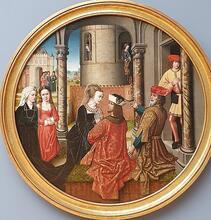
Joseph meets Asenath (Asenath throws the Idols out of the Tower), Brussels 1490-1500, artist unknown. Source: Bodes Museum Berlin, via Wikimedia Commons
Asenath is mentioned only briefly in Gen 41:45, 50 and Gen 46:20. However, her story was re-narrated as a love story written in ancient Greek some time between 100 BCE and 200 CE, likely in Egypt, and today called Joseph and Aseneth. This novel is more than a simple love and adventure story. It takes part in the multiform Jewish Hellenistic discourse on identity, ethics, wisdom theology, and the Biblical figures Dinah, Joseph, and Joseph’s brothers. More than 90 manuscripts, translations, poems, and images prove the multiform and sometimes controversy reception in Jewish, Islamic, and Christian quarters.
Although the Bible says little about Asenath (Aseneth in the Greek translation, the Septuagint [LXX]), the wife of Joseph, she became the main character of a widely known Jewish novel from Hellenistic or Roman times, known today as Joseph and Aseneth (Jos. Asen.). Alternatively, one Targum (Pseudo-Jonathan) and some A type of non-halakhic literary activitiy of the Rabbis for interpreting non-legal material according to special principles of interpretation (hermeneutical rules).Midrashim know her as either the daughter of the wife of Potiphar (Jub 40:10; Bereshit Rabba 85.2; cf. Origen, Commentarii in Genesim MPG 12.136 ) or the offspring of Dinah’s rape, who was brought to Egypt where she married Joseph and was reintegrated into Jacob’s family (Targum Pseudo-Jonathan on Gen 41:45; 46:20; Soferim 21 4[3b]; Pirqe Rabbi Eliezer 36, 38).
A Biblical Character Becomes the Main Character of an Ancient Jewish Novel
In the Bible, Pharaoh honors Joseph by giving him as a wife Asenath, “the daughter of Potiphera, priest from the city of On” (LXX: Heliopolis; Gen 41:45). She is the mother of Manasseh and Ephraim (Gen 41:50; 46:20). Her Egyptian name likely derives from Nś-Nἰ, “the one that belongs to the Goddess Neith.” Most Jewish authors in Hellenistic and Roman times seem to have no problem with her Egyptian origin or religion (Philo, De Josepho 121; De somniis 1.78, Josephus, Antiquities 2.91–92). But Joseph and Aseneth tells of her conversion, her marriage to Joseph, and how she is saved from being raped like Dinah (Genesis 34). On the surface this is a love story that belongs to the genre of the ancient erotic novel. It follows its basic storyline in which a heroine and a hero fall in love at first sight, marry after some inner struggles, are unfortunately separated, and go through adventures and attacks on their chastity until they finally find each other through the help of a god (see Xenophon of Ephesus, Ephesiaca, and Chariton, De Charea et Callirhoe). Yet here romantic love and conversion to Joseph’s god are intermingled.
The Storyline of Joseph and Asenath
At the beginning, Asenath—like the heroine of the ancient romance—is the most beautiful Egyptian priestess, desired by all kings but living ascetically in a tower beside her father’s house (Jos. Asen. 1–2). She refuses to marry Joseph, whom her father describes as “powerful in wisdom and bearer of God’s spirit” (Jos. Asen. 4:7–9). But when she sees Joseph for the first time, she realizes her mistake because she sees the “son of God, whom nothing hidden escapes” (Jos. Asen. 6). This description of Joseph could be an interpretation of his Egyptian name, Zaphenath-paneah (Gen 41:45). Joseph, too, is not happy when he first sees her, but then he blesses her and asks God for her renewal (Jos. Asen. 8). After his departure, she repents for seven days with fasting and self-abasement (Jos. Asen. 9–11). On the eighth day, she prays to God with a psalm that picks up many biblical motifs (Jos. Asen. 12; cf. Pss 135; 104:27; 142; and others). Then a man (anthropos) appears from heaven in the shape of the angel of Dan 10:5–10 and tells her that she is heard and renewed by God, who has already given her as a fiancée to Joseph. Her name is no longer Asenath but “city of refuge.”
At this point (Jos. Asen. 15:7–8), the text describes the heavenly figure Metanoia (“change of mind, repentance”), who is modelled upon personified wisdom (Proverbs 8; Sirach 24; Wisdom of Solomon 6–10; 1 Enoch 42; Philo, De Somniis 2.292; Testament of Gad 5:7-8). Her transformation is shown by new shining clothes (cf. 2 Enoch 22). Then Asenath shares a honeycomb with the heavenly being (Jos. Asen. 16) before he leaves, like Elijah, in a chariot of fire (Jos. Asen. 17). This scene and others probably have one or more symbolic meanings, which have not been fully deciphered. In the next chapters, Asenath meets Joseph again, reunites with him, and marries him (Jos. Asen. 18–21).
Although some interpreters think that the story comes to a happy end here, the remaining seven chapters are an integral part of the story. The son of Pharaoh—first mentioned in Jos. Asen. 1—plans to capture and rape Asenath, as the wife of Potiphar planned to capture Joseph in Genesis 39 and its re-narrations (Testament of Joseph; Josephus, Jewish Antiquities 2.39–59). However, unlike her sister-in-law Dinah (Genesis 34), Asenath is not raped but stops the revenge through the ethical maxim “Do not repay evil for evil to anyone” (Jos. Asen. 28; 1 Thess 5:15; Rom 12:17). With this, Joseph and Aseneth is related to Genesis 34, one of the most discussed biblical texts in Hellenistic-Jewish literature.
Joseph and Asenath among Jewish and Christian Interpreters
Joseph and Aseneth was written in Greek and is preserved in over ninety manuscripts in seven languages (Greek, Syriac, Armenian, Slavonic, Latin, Rumanian, and modern Greek). Because manuscripts differ widely, the question of which manuscripts preserve the oldest text is still under debate. In transmission Joseph and Aseneth shares the fate of many extra-canonical writings. Retelling and oral transmission affects the text so that there was probably never one sole text. Moreover, some manuscripts reflect an ongoing discussion on the role of women and on the markers of Jewish ethnicity, identity, and ethics. Three Greek and some Armenian manuscripts are illustrated.
Scholars do not agree on the social context and purpose of the book. Some consider it a roman à clef situated in Egyptian Judaism at the founding of the temple at Leontopolis or the pogrom in Alexandria in 38 CE. While most scholars agree that it is a Jewish work written before 115–117 CE, some argue for a Christian provenance, for conversion is central in Joseph and Aseneth but Torah and Sabbath are not mentioned. Still, the book reflects biblical exegesis on Genesis 34 and 39 that was also prominent in contemporary Jewish Hellenistic writings (Jubilees 30; Jdt 9; Testament of Levi; Theodotus, On the Jews; Josephus, Antiquities 1.337–341; Philo, On the Migration of Abraham 223–225). The appearance of the heavenly being reveals to Asenath that Metanoia is heavenly wisdom and indicates that she is the main agent in Asenath’s life. This suggests that Joseph and Aseneth, like Wisdom of Solomon and Philo of Alexandria, belongs to Jewish wisdom theology. The story relates not only a conversion to Israel’s God but also a change of mind that opens Asenath to her true heavenly reality. As a daughter of God she is bound to God’s other sons and daughters. Together with them she is no longer vulnerable in this world but studies the heavenly scriptures with Levi (Jos. Asen. 22) and helps to change the world for the better, because the wise and righteous ones rule the country (Jos. Asen. 28–29).
History of Interpretation
The romantic love between Asenath and Joseph has been discussed in at least three religions since antiquity. Rabbinic interpretations list Asenath among the most famous biblical proselytes, along with Jael, Hagar, Shiphrah, Puah, the unnamed daughter of Pharaoh, Zipporah, Rahab, and Ruth (Kohelet Rabbah 8.10.1). Some place Joseph and Asenth in Jewish mysticism and Kabbalistic works. In Islamic traditions, some poems on Yusuf and Zuleika, as Joseph and Potiphar’s wife are called here, have Zuleika removing her foreign gods and spending her life in repentance before she becomes Joseph’s wife after many years. These poems likely took some motifs from the storyline of Joseph and Aseneth. In Christianity, the pilgrim Egeria saw Asenath’s tower in Egypt when she traveled as a pilgrim to the Holy Land in the fourth century CE (Egeria, Itenarium 7.1 [9.1.6]). In the sixth century CE some read Joseph and Aseneth as an allegory to Christ’s marriage to the soul (Chronicle of Pseudo-Zacharias Rhetor I.6). In twelfth- century England, Christian monks translated Joseph and Aseneth into Latin to convince Jewish women to convert to Christianity. And in the fifteenth century CE, Asenath apparently paved the way for English noblewomen to enter a religious life in marriage. Changing concepts of gender, status, ethnos, and religion have left traces in the textual transmission of the story.
Ahearne-Kroll, Patricia. Aseneth of Egypt: The Composition of a Jewish Narrative: Reconstructed Texts and Their Limitation. Early Judaism and Its Literature 56. Atlanta: Society of Biblical Literature, 2020.
Aptowitzer, Victor. “Asenath, the Wife of Joseph. A Haggadic Literary-Historical Study.” Hebrew Union College Annual 1 (1924): 239–306.
Bohak, Gideon. Joseph and Asenath and the Jewish Temple in Heliopolis. SBL Early Judaism and its Literature Series. Atlanta: Scholars Press, 1996.
Burchard, Christoph. Gesammelte Studien zu Joseph & Aseneth. Leiden: Brill, 1996.
Chesnutt, Randall D. “Revelatory Experiences Attributed to Biblical Women in Early Jewish Literature.” In Women Like This. New Perspectives on Jewish Women in the Greco-Roman World. Society of Biblical Literature Early Judaism and its Literature 1, edited by Amy-Jill Levine, 107–125. Atlanta: Scholars Press, 1991.
Goodacre, Mark. The Aseneth Home Page, http://markgoodacre.org/aseneth/
Hezser, Catharine. “Joseph and Aseneth in the Context of Ancient Greek Erotic Novels.” Frankfurter Judaistische Beiträge 24 (1997): 1–40.
Hicks-Keeton, Jill. “Aseneth between Judaism and Christianity: Refraiming the Debate.” Journal for the Study of Judaism 49 (2018): 189–222. doi.org/10.1163/15700631-12492208.
Humphrey, Edith M. Joseph and Aseneth. Guides to Apocrypha and Pseudepigrapha. Sheffield: Sheffield Academic Press, 2000.
Kraemer, Ross S. When Aseneth Met Joseph: A Late Antique Tale of the Biblical Patriarch and His Egyptian Wife, Reconsidered. Oxford: Oxford University Press, 1998.
Nickelsburg, George W. E. “Stories of Biblical and Early Post-Biblical Times.” In Jewish Writings of the Second Temple Period, edited by Michael E. Stone, 33–87. Compendia Rerum Iudiaricum ad Novum Testamentum. Assen: Van Gorcum, 1984.
Nir. Rivka, Joseph and Aseneth: A Christian Book. Hebrew Bible Monographs 42. Sheffield: Sheffield Phoenix, 2012.
Nisse, Ruth. “‘Your Name Will No Longer Be Aseneth.’ Apocrypha, Anti-martyrdom, and Jewish Conversion in Thirteenth-Century England.” Speculum 81 (2006): 734–53. https://www.journals.uchicago.edu/doi/pdf/10.1017/S0038713400015694.
Reiss, Moshe and Zucker, David J., “Co-opting the Secondary Matriarchs: Bilhah, Zilpah, Tamar, and Aseneth.” Biblical Interpretation 22 (2014): 307–24. https://doi.org/10.1163/15685152-00223p04.
Sänger, Dieter. “Erwägungen zur historischen Einordnung und zur Datierung von ‘Joseph und Aseneth.’” Zeitschrift für alttestamentliche Wissenschaft 76 (1985): 86–106. doi.org/10.1515/zntw.1985.76.1-2.86.
Schneider, Michael. “Joseph an Aseneth and Early Jewish Mysticism.” Kabbalah: Journal for the Study of Jewish Mystical Texts 3 (1993): 303-44 (Hebrew).
Standhartinger, Angela. “Recent Scholarship on Joseph and Aseneth (1988-2013).” Currents in Biblical Research 12 (2014): 353–406. doi.org/10.1177/1476993X14526968
Standhartinger, Angela. “Seeing or Tasting? Human’s Perception of the Heavenly World in Hellenistic Jewish Writings.” In Ancient Jewish Review (October 2020) (https://www.ancientjewreview.com/articles/2020/4/2/sbl-2019-review-panel-seeing-or-tasting-humans-perception-of-the-heavenly-world-in-hellenistic-jewish-writings
Standhartinger, Angela, Das Frauenbild im Judentum der hellenistischen Zeit. Ein Beitrag anhand von Joseph und Aseneth (AGJU 26). Leiden: Brill, 1995.
Standhartinger, Angela, “Humor in Joseph and Aseneth,” Journal for the Study of Pseudepigrapha 23 (2015): 239–59. doi.org/10.1177/0951820715590541.
Standhartinger, Angela. “Intersections of Gender, Status, Ethnos and Religion in Joseph and Aseneth in Early Jewish Writings.” In Early Jewish Writings, edited by Eileen Schuller and Marie-Theres Wacker, 69–87. The Bible and Women 3.1. Atlanta: SBL Press, 2017.
Warren, Meredith J. C. Food and Transformation in Ancient Mediterranean Literature Writings from the Greco-Roman World Supplement 14. Atlanta: SBL Press, 2019.
Wills, Lawrence M. The Jewish Novel in the Ancient World. Ithaca and London: Cornell University Press, 1995.
Wills, Lawrence M. “Jewish Novellas in a Greek and Roman Age: Fiction and Identity”, Journal for the Study of Judaism 42 (2011): 141–65. doi.org/10.1163/157006311X544409








)-Bode_museum-_Berlin.jpg)