Discover the treasures at JWA's new offices in Brookline Village

by 

In early January, JWA moved its offices to an historic building in Brookline Village, a half mile down Harvard Street from our home for the past six years. After weeks of packing and un-packing, we are settled in a bright and sunny space and finally know where things are. Since most of you may find it hard to drop in on us—although you are welcome anytime—we thought it would be fun to give you a short “virtual tour” and show you a few of the treasures we brought with us to the new space.

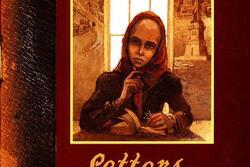
As they walk through the door, JWA visitors are greeted by Rebecca Rubin, a nine-year-old Jewish American immigrant from 1914. Not to be confused with Rebecca Rubin, the fugitive, indicted for arson in 2006 according to her FBI WANTED poster, this Rebecca Rubin is the Jewish American Girl™ Doll. According to the story told in her companion book Meet Rebecca, Rebecca’s family emigrated from Russia to the Lower East Side in New York.

While JWA has no affiliation with American Girl™, and we feel uncomfortable with the doll’s stiff $105.00 price, we think she’s a starting point for discussion about Jewish American identity. Her hair and eye color sparked debates about what it means to “look Jewish,” and her story (she dreams of becoming an actress and, in one book, participates in a labor strike) raises questions about how we define the “typical” Jewish experience in America.

In 2004, JWA sponsored Andrea Kalinowski's Stories Untold: Jewish Pioneer Women 1850–1910 exhibition at the Boston Public Library as part of our 350th anniversary program events. Kalinowski’s multimedia canvases bring together quotations from diaries and news stories, photographs, and quilt patterns to tell stories from the lives of nine Jewish pioneer women. They also inspired the feature on jwa.org on Jewish women pioneers in the American West.

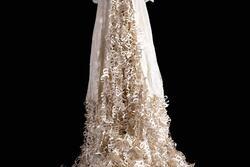
JWA was lucky to receive one of the pieces as a gift from Founding JWA Board Chair Barbara Dobkin—a quilt telling the story of Anna Marks. In 1880, Anna Marks and her husband immigrated to America and settled in Eureka City, a rich mining area 60 miles south of Salt Lake City. Anna Marks made a fortune in real estate and owned controlling interests in two mines near Eureka. She also invested money in diamonds. Not afraid to pull her guns on men who crossed her, Anna gained a reputation for being “the feistiest woman in the state.”

Today, Anna Marks’ quilt hangs in JWA’s conference room, inspiring us to live up to her fearless legacy.

In 1997, JWA completed its first oral history project conducting interviews with women of Temple Israel in Boston whose lives spanned the 20th century. The combination of oral history interviews, photographs, and works of art inspired by them earned JWA the Exceptional Program of 1997-1998 award from the JCC of Greater Boston. The Women Whose Lives Span the Century project inspired JWA’s next oral history endeavors in Baltimore and Seattle. These oral history projects were the basis for developing our oral history guide.

Today, this certificate is framed and displayed on a wall in our front hall where it reminds us how much we have done over the past 15 years to advance JWA's mission—to uncover, chronicle, and transmit to a broad public the rich history of American Jewish women.

In March 2005, JWA held its first New York gala—So Laugh a Little: An Evening of Jewish Women's Comedy Honoring Barbara Dobkin. The Founding Chair of the Jewish Women’s Archive, Barbara Dobkin has broken new ground in both Jewish and secular philanthropy. She is known for her cheeky sense of humor, so it made sense to honor her, and her contributions to JWA, with a night of comedy.

So Laugh a Little was held at the Copacabana in New York City. Each guest received a Barbara Dobkin mask and a pink feather boa. The event laid the foundation for JWA’s acclaimed documentary film about Jewish women in comedy, Making Trouble.

This is the first edition of the Our Bodies, Ourselves coursebook produced by the Boston Women’s Health Book Collective in 1971. Of the 12 women who worked on the project, nine were Jewish, including Esther Rome, Joan Ditzion, Nancy Miriam Hawley, who is featured in JWA’s web exhibit Jewish Women and the Feminist Revolution, and Paula Doress-Waters who contributed a scan of the cover to the exhibit.

This framed image hangs in the office of Judith Rosenbaum, JWA’s Director of Public History. JWA presented it to Judith in September of 2005 in recognition of her work on the Feminism exhibit. Judith says she loves the image because it captures so beautifully how Our Bodies, Ourselves evolved.

“At some point in these early printings, we realized that the title ‘Women and Their Bodies’ was itself a sign of our alienation from our bodies,” Nancy Miriam Hawley told JWA. “We changed the title to ‘Our Bodies, Ourselves,’ because that was what we were really talking about.”

In JWA Executive Director Gail T. Reimer’s sunny office you will find this print by artist Joan Snyder. Commissioned by The Jewish Museum in New York City, it includes the names of every woman, Jewish and non Jewish, whose name appears in the Bible. Joan Snyder and a photograph of her print by Sheldan Collins are featured in JWA’s exhibit Jewish Women and the Feminist Revolution.

Before founding JWA in 1995, Gail T. Reimer conceived and co-edited the path-breaking anthology of Jewish women’s writings—Reading Ruth: Women Reclaim a Sacred Story. Working on this project led Gail to see that contemporary Jewish women’s stories were likely to suffer the same fate as Biblical women’s stories if something weren’t done about collecting and preserving them. That realization led to the founding of the Jewish Women’s Archive.

1 of 1

Comments

New JWA Offices and Rebecca Rubin

Love the welcome by Rebecca to the new JWA offices. Had no idea she was part of the American Girl's Collection. Wonderful!

Post new comment

The content of this field is kept private and will not be shown publicly.
  • Web page addresses and e-mail addresses turn into links automatically.
  • Allowed HTML tags: <p> <br /> <br> <a> <em> <i> <strong> <cite> <code> <ul> <ol> <li> <dl> <dt> <dd> <span> <sup>
  • Lines and paragraphs break automatically.

More information about formatting options